How Much Does Kids' Sport Cost in Australia? $4,567 a Year, and Which Sports Cost the Most (2026)
25 August 2026
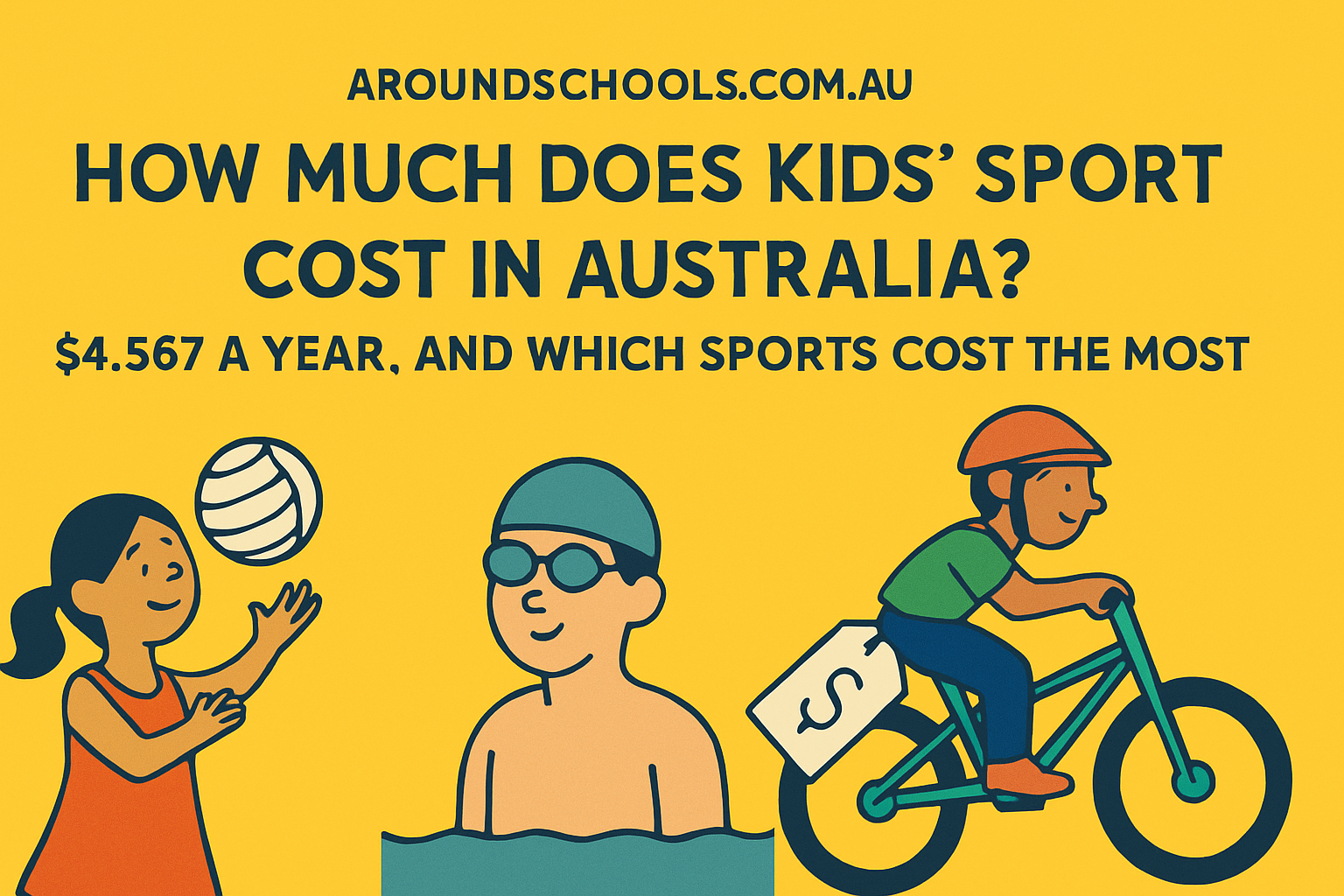
Community sport costs an Australian family $4,567 a year per child on average. That is the headline of the first national study of what parents actually pay, published on 18 August 2026 in the journal Frontiers in Sports and Active Living by Rochelle Eime, Hans Westerbeek, Melanie Charity and Katherine Owen, from a survey of 5,533 sport participants — 2,457 of them children under 18. Seventy-eight per cent of the families with children said cost was a limiting factor in the decision to play at all.
The average hides a fourteen-fold spread. Water polo came in at $15,694 a year and equestrian at $13,947; at the other end, taekwondo cost $1,127 and softball $1,643. Netball ($7,543), swimming ($8,151) and even surf life saving ($10,239) — the sports most Australian children actually do — all sit above the average.
Below: every sport in the study ranked, what the money actually goes on, why the bill has grown four to seven times faster than inflation, and the state voucher schemes — most of which have a round open right now — that take $100 to $500 off it.
Key takeaways
- $4,567 a year per child, on average, for community-level sport in Australia (survey period October–December 2024; published August 2026).
- Getting started costs $1,161 — registration $474, equipment $379, uniform $307. The other $3,400 is coaching, competition fees, travel, accommodation and parents' lost work time.
- Most expensive: water polo $15,694, equestrian $13,947, BMX/mountain bike $11,689, surf life saving $10,239, swimming $8,151. Cheapest: taekwondo $1,127, softball $1,643, athletics $1,970, roller sports $2,518.
- Costs nearly doubled between 2018–19 and 2022–23 while CPI rose about 14–15% — four to seven times the rate of general inflation, in the authors' words.
- 78% of families with children say cost limits participation, rising to 78% for culturally and linguistically diverse families and 72% in the most disadvantaged areas.
- Every state and territory except the ACT runs a sport voucher, from $100 to $500 a year per child. Most rounds for 2026–27 opened in July; Victoria's opens in September.
Every sport in the study, ranked
These are the average total annual costs for children, as reported by the families surveyed. Bear in mind that "total" includes everything — travel to a regional carnival counts, and so does the wage a parent gave up to drive there.
| Sport | Average annual cost per child |
|---|---|
| Water polo | $15,694 |
| Equestrian | $13,947 |
| BMX / mountain bike | $11,689 |
| Surf life saving | $10,239 |
| Swimming | $8,151 |
| Netball | $7,543 |
| Tennis | $7,320 |
| Gymnastics | $6,416 |
| Basketball | $6,369 |
| Hockey | $6,043 |
| Football (soccer) | $5,622 |
| Touch | $4,981 |
| Cricket | $4,931 |
| Rugby league | $4,903 |
| Baseball | $4,815 |
| Rugby union | $4,759 |
| Dance sport | $4,541 |
| Golf | $4,286 |
| Australian football | $3,896 |
| Karate | $3,346 |
| Volleyball | $3,184 |
| Calisthenics | $3,082 |
| Roller sports | $2,518 |
| Athletics | $1,970 |
| Softball | $1,643 |
| Taekwondo | $1,127 |
Two patterns are worth pulling out. First, the four dearest sports are all ones where the equipment, the animal or the venue is the cost: a horse, a bike, a pool, a surf club's carnival calendar. Second, the big winter team codes cluster in a surprisingly tight band — football $5,622, cricket $4,931, rugby league $4,903, rugby union $4,759, Australian football $3,896 — and AFL is the cheapest of them by a clear margin.
What the $4,567 is actually made of
The part parents budget for — signing up — is only a quarter of the bill. The study puts the entry-level cost at $1,161: registration or membership $474, equipment $379, and uniform or clothing $307. Everything after that is where the money goes:
- Coaching is the biggest divider between sports. In individual sports it averaged $1,363 a year; in team sports, $284. If you are choosing between swimming squad and a football club on cost alone, that line is most of the difference.
- Competition and tournament fees: $309 a year in individual sports, $118 in team sports.
- Travel: $428 a year for families in major cities, $790 for regional and remote families — and accommodation on top, $386 in the cities and $714 in the regions. Distance is a cost that never appears on the club's fee sheet.
- Lost parental income: about $1,000 a year — $1,034 for individual sports and $935 for team sports — for the hours a parent spends driving, waiting and volunteering instead of working.
Adults, for comparison, spend an average of $2,894 a year on their own sport. A child's sport costs more than a parent's largely because of the coaching and the driving.
Four to seven times faster than inflation
The study compares its figures with earlier Australian data and finds that between 2018–19 and 2022–23 "children's sport participation costs nearly doubled (+100%), and adult costs rose by approximately 64%, meaning sport costs rose at four to seven times the rate of general inflation". Over the same period the Consumer Price Index rose by roughly 14–15%. The authors put it plainly: "if children's sport costs had risen in line with CPI, the average cost in 2022–2023 would have been approximately $785 rather than $1,369" for the like-for-like measure they tracked.
That is the context for the 78%. Cost was a limiting factor for 67% of all participants, but the burden is not evenly spread: 78% of children's families against 59% of adults; 78% of culturally and linguistically diverse participants against 66%; 75% of participants with a disability against 66%; 73% in team sports against 59% in individual sports; and 72% of families in the most disadvantaged areas against 63% in the most advantaged. Sport is getting dearer fastest for the children who have the most to gain from it.
The state vouchers, and which rounds are open now
Every state and territory except the ACT runs a voucher scheme, and because most reset on 1 July, the 2026–27 rounds are largely open as this is written. Values and rules as published on each government's own page in August 2026:
| State / territory | Scheme | Value per child | Who is eligible | Timing |
|---|---|---|---|---|
| NSW | Active and Creative Kids | $50, twice a year ($100) | School-aged children in families receiving Family Tax Benefit | One voucher from 15 January (use by 31 December), one from 15 July (use by 14 July the following year) |
| Victoria | Get Active Kids Voucher | Up to $200 | Children aged 0–18 named on a valid Health Care Card or Pensioner Concession Card | Applications open during September |
| Queensland | Play On! Sports Vouchers (formerly FairPlay) | $200, one per financial year | Every Queensland child aged 5–17 | Round 2 ran 29 January – 12 June 2026; new vouchers from July 2026 |
| Western Australia | KidSport | Up to $500 per financial year | Children aged 5–18 named on a current Health Care Card or Pensioner Concession Card | New funding round from 1 July each year |
| South Australia | Sports Vouchers | Two $100 vouchers a calendar year ($200) | Every child in Reception to Year 9 — no concession card needed | Calendar year |
| Tasmania | Ticket to Play | Two vouchers of up to $100 each ($200) | Children aged 5–18 on a Health Care or Pensioner Concession Card, or whose family received Family Tax Benefit A | Applications open 6 July 2026 – 28 May 2027 |
| Northern Territory | Sport Voucher Scheme | $100, twice a financial year ($200) | Every NT child from Transition to Year 12 enrolled at school or in home schooling | July and January; 2026–27 applications opened 1 July 2026 |
Three things follow from the table. Queensland, South Australia and the Northern Territory are universal — no concession card, every child — so a family that has never applied is simply leaving $200 on the table. Western Australia's KidSport is the most generous in the country at up to $500 but is means-tested. And NSW's $50 is the smallest, which is why it pays to time a club registration to the 15 July release so both of the year's vouchers land inside one season.
Set against the $474 the study reports for registration alone, a voucher covers somewhere between a fifth of that (NSW) and all of it plus the uniform (WA). None covers coaching or travel, which is where the bill for individual sports really lives.
How to bring the number down
None of this means a child should not swim or play netball. It means the cost is now large enough to plan around, the way school fees are. What the study's own breakdown suggests:
- Take the voucher, every year. The table above. Most clubs are registered providers and will apply it at checkout.
- Team sports are cheaper to coach. $284 a year against $1,363. A child who loves both basketball and gymnastics costs a family roughly $1,000 a year less in the team sport, before anything else.
- Distance is a fee. Regional families pay nearly twice the travel and accommodation of city families. A club 5km away beats a better club 30km away on total cost by more than the registration difference — and on the parent's lost income, which the study counts and most families do not.
- Buy equipment second-hand and uniforms once. Equipment ($379) and uniform ($307) are the two entry costs that resell; most clubs run a swap or a second-hand board at the start of the season.
- Ask about hardship and instalment plans before you walk away. The study found 78% of families feel cost limits participation; clubs know this, and many carry quiet hardship funds and monthly-payment options that are never on the website.
- Start with the free trial rounds. Term 4 and January are when clubs run come-and-try days, and they are the cheapest way to find out which sport a child will actually stick with before paying a year's registration.
Sport makes up the large majority of the 7,911 kids' activities listed on AroundSchools across 2,836 suburbs, and you can browse what runs near you — including the low-cost council programs and free come-and-try sessions — on the activities finder. Where each suburb stands on activity supply is in our Kids' Activity Index. For the other big cost line in a sporting childhood, the away tournaments and sports tours, see our guide to the first time they play away from you.
Frequently asked questions
How much does kids' sport cost in Australia per year?
$4,567 a year per child on average, according to a national study of 2,457 children published in Frontiers in Sports and Active Living in August 2026. The figure includes registration, uniform, equipment, coaching, competition fees, travel, accommodation and parents' lost income. Entry-level costs alone — registration, uniform and equipment — average $1,161.
What is the cheapest sport for kids?
Of the 26 sports in the study, taekwondo was cheapest at $1,127 a year, followed by softball ($1,643), athletics ($1,970) and roller sports ($2,518). Among the major team codes, Australian football was cheapest at $3,896.
What is the most expensive sport for kids?
Water polo, at $15,694 a year, followed by equestrian ($13,947), BMX and mountain biking ($11,689) and surf life saving ($10,239). Swimming ($8,151), netball ($7,543) and tennis ($7,320) were the dearest of the mainstream sports.
Why are kids' sport costs rising so fast?
The study found children's participation costs nearly doubled between 2018–19 and 2022–23, against a roughly 14–15% rise in CPI — four to seven times the rate of general inflation. Coaching, facility hire, travel and competition fees have all outpaced club registration.
What sport vouchers are available in 2026?
NSW Active and Creative Kids ($50 twice a year, Family Tax Benefit families), Victoria's Get Active Kids Voucher (up to $200, concession-card families, opens in September), Queensland's Play On! Sports Vouchers ($200, every child aged 5–17), WA KidSport (up to $500, concession-card families), SA Sports Vouchers (two $100 vouchers, every child Reception to Year 9), Tasmania's Ticket to Play (two vouchers up to $100, concession or FTB A families) and the NT Sport Voucher ($100 twice a year, every enrolled child). The ACT has no equivalent scheme that we could find.
Does the $4,567 figure include travel and parents' time?
Yes. It is the average total cost reported by families, including travel ($428 in cities, $790 in regional areas), accommodation, and around $1,000 a year in lost parental income. Registration, uniform and equipment alone average $1,161.
Source: Eime R, Westerbeek H, Charity M and Owen K, "Cost to play community-level sport in Australia", Frontiers in Sports and Active Living, 18 August 2026, doi.org/10.3389/fspor.2026.1891152. Survey of 5,533 participants (2,457 children) conducted October–December 2024. Voucher details from each state and territory government's program page, August 2026 — values and dates change each round, so confirm before applying. Cite this: "Kids' sport costs Australian families $4,567 a year per child — AroundSchools, August 2026."