The Year 7 Cliff: When Australian Private School Fees Actually Jump
24 August 2026
The Year 7 Cliff: When Australian Private School Fees Actually Jump
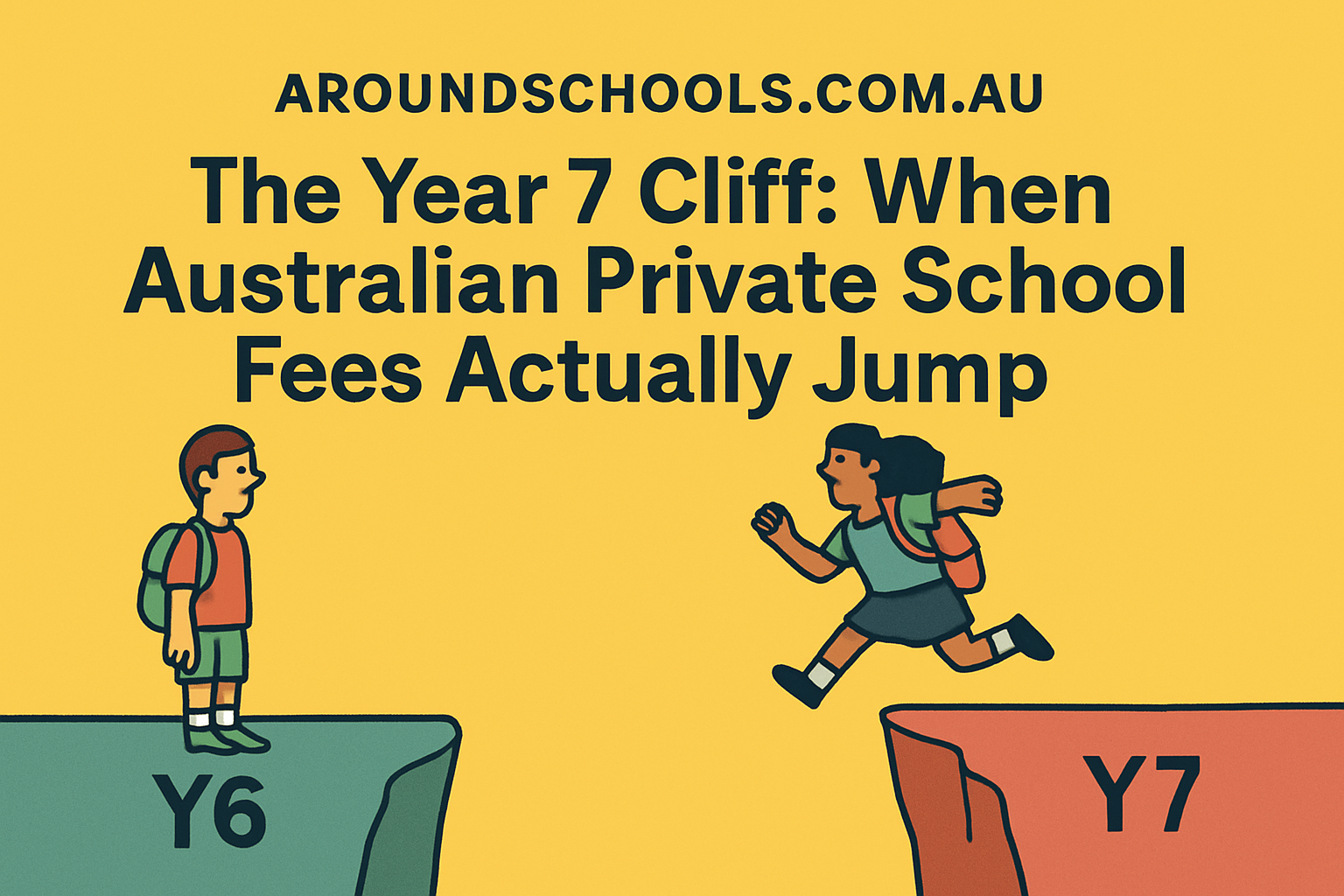
Private school fees do not climb in a straight line. They sit almost flat through primary school, then step up the year your child starts secondary — and again in the senior years. For a family that has budgeted comfortably through primary, Year 7 is often the moment the numbers stop working.
But the size of that step depends entirely on the kind of school, and it looks like a different number depending on whether you read it as a percentage or in dollars. Here is what the jump actually looks like, measured from real 2026 fee schedules we read at each school and diocese this month — not a market average.
Why we don't quote a single "average Year 7 jump". Schools and dioceses publish fees on incompatible bases — systemic "capacity to contribute" tuition, independent market tuition, fees banded across year levels, per-family levies — and most of the change happens at the one primary-to-secondary line rather than smoothly between calendar years. An average across all of that is precise-looking and misleading. So instead we show the real step at named schools in both sectors.
Key takeaways
- The jump is a primary-to-secondary step, not a gradual climb. Primary tuition is close to flat; Year 7 is where it moves.
- In percentage terms, the jump is biggest at systemic Catholic schools — because their primary fees are heavily subsidised. The Archdiocese of Canberra & Goulburn's systemic tuition rises about 84% from primary to Year 7; the Diocese of Parramatta's rises 39%; Sydney Catholic's 30%.
- In dollars, independent schools jump the most. Pymble Ladies' College rises $7,980 from Year 6 to Year 7 and Canberra Grammar $4,655, against a few hundred to a few thousand dollars at the systemic schools.
- It is not universal. The Diocese of Wollongong bands its primary and Year 7 tuition close together — a rise of just 13% — so check your own school's schedule rather than assuming a cliff.
- Year 7 is also when the extras arrive — one-to-one device programs, camps and senior levies — so the tuition step understates the budget step.
The jump is a primary-to-secondary step
The cleanest way to see it is inside a single school that publishes a fee for every year level. Tuition barely moves through primary, then steps up at Year 7 — the year the child changes campuses, picks up specialist subjects, and at many schools starts a one-to-one device program.
These are 2026 figures we read from each school's or diocese's own schedule this month:
| School / system | Sector | Year 6 tuition | Year 7 tuition | The step |
|---|---|---|---|---|
| Diocese of Parramatta (systemic) | Catholic | $1,824 | $2,532 | +$708 (+39%) |
| Sydney Catholic Schools — St Mary's Cathedral College | Catholic | $5,351 | $6,980 | +$1,629 (+30%) |
| Archdiocese of Canberra & Goulburn (systemic) | Catholic | $3,325 | $6,116 | +$2,791 (+84%) |
| Diocese of Wollongong (systemic) | Catholic | $1,898 | $2,150 | +$252 (+13%) |
| Canberra Grammar School | Independent | $29,050 | $33,705 | +$4,655 (+16%) |
| Pymble Ladies' College | Independent | $36,730 | $44,710 | +$7,980 (+22%) |
Systemic figures are the diocesan tuition / system fee only, first child — building and facilities levies are charged on top. Independent figures are tuition only. All read from each body's own 2026 schedule in September 2026; the Canberra-Goulburn and Wollongong primary figures are the diocese's published primary rate rather than an individual school's own schedule.
Why the percentage and the dollars disagree
This is the part that gets mangled in the retelling, so it is worth slowing down.
Systemic Catholic schools make a big percentage jump and a small dollar one. Their primary fees are deliberately low — set by a family's capacity to contribute rather than a market — so even a modest dollar rise at Year 7 lands as a large proportional shock. A Parramatta family paying about $1,800 a year suddenly needs closer to $2,500: only $708 more, but nearly 40% more. That is the jump that catches systemic-school families off guard.
Independent schools make a big dollar jump and a modest percentage one. They already charge a market price in primary, so Year 7 adds thousands of dollars but only a sixth or a fifth on top. Pymble's $7,980 step is eleven times Parramatta's in dollars, yet half of it in percentage terms.
And it is not a universal law. The Diocese of Wollongong bands its primary and Year 7 tuition close together, so its step is just 13%. The only way to know your school's shape is to ask for its full fee schedule, every year level, in writing.
Why Year 7 is where it happens
The step is not arbitrary. Secondary schooling genuinely costs more to deliver:
- Specialist staff. Primary teachers cover most of the curriculum; secondary schools run separate teachers for maths, each science, languages, music and technology.
- Specialist facilities. Science laboratories, workshops, performing-arts spaces and senior sports facilities are secondary infrastructure, and they carry maintenance and replacement costs.
- Smaller senior classes. Subject choice fragments year groups into smaller teaching sets, especially from Year 11.
- Devices and programs. Year 7 is the common entry point for one-to-one laptop programs, camps and immersion trips, several billed separately again.
At systemic Catholic schools there is a second reason on top of all this: primary fees are held deliberately low, so the Year 7 rise is partly the subsidy easing rather than the cost of secondary alone.
The full journey, not just one year
The more useful figure than any single year is the total. Futurity Investment Group's 2026 Cost of Education Index puts the 13-year metropolitan cost of schooling at about $247,174 for a Catholic education and $369,594 for an independent one — figures that include levies, uniforms, devices and camps, not tuition alone. (Futurity reports a single K-12 total, not a primary/secondary split, so treat any "secondary costs X" figure with care.) Either way, the back half of schooling carries most of the spend, and the Year 7 step is where it starts.
For the six-year secondary math and the ways families actually fund it — income, discounts, scholarships and education bonds — see what six years of private school actually costs. For how the two sectors compare overall, see Catholic versus independent school fees.
What to do with this
- Ask for the full fee schedule, not the current year. Any school will provide fees for every year level. The Year 3 number is not the one that will hurt.
- Budget the Year 7 step explicitly — and if you are looking at systemic Catholic schools, budget it as a percentage, not a dollar figure, because that is where the surprise is.
- Check the extras separately. Building and facilities levies, devices, camps and uniforms are not in any of the tuition figures on this page.
- Don't skip the public option. A zoned government high school is free; you can check any address on our catchment checker.
- Remember fees rise every year on top of the step. Private school fees have been climbing about 5-6% a year — roughly double CPI (ABS, via Futurity's 2026 index) — so a Year 7 fee quoted today will be higher by the time your younger child gets there.
Frequently asked questions
How much do private school fees jump at Year 7? It depends on the school. At systemic Catholic schools the rise is large in percentage terms — roughly 30% to 84% across the dioceses we checked — because primary fees are heavily subsidised. At independent schools the rise is a few thousand dollars but a smaller proportion, around 16% to 22%. One diocese we checked (Wollongong) rose just 13%, so there is no single number.
Why do fees rise so much at Year 7? Because secondary schooling costs more to deliver — specialist staff and facilities, smaller senior classes, and device programs that start in Year 7 — and, at systemic Catholic schools, because the low primary subsidy eases as students move into secondary.
Is the jump bigger at Catholic or independent schools? Bigger in percentage terms at systemic Catholic schools; bigger in dollars at independent schools. They are answering different questions: your proportional budget shock versus the size of the cheque.
What is the total cost of a private education? Futurity's 2026 index puts the 13-year metropolitan total at about $247,174 (Catholic) and $369,594 (independent), including levies and ancillaries. See what six years of private school actually costs for the secondary-years detail.
School and diocesan fee figures are each body's own published 2026 schedule, read at source in September 2026; systemic figures are tuition / diocesan fee only (levies charged separately), and the Canberra-Goulburn and Wollongong primary rates are the diocese's published figure rather than an individual school's schedule. Fees change annually — confirm with the school before enrolling. AroundSchools holds no academic results and does not rank schools on quality.