Help with school costs, state by state (2026): the payments, allowances and fee waivers you can still claim
3 September 2026
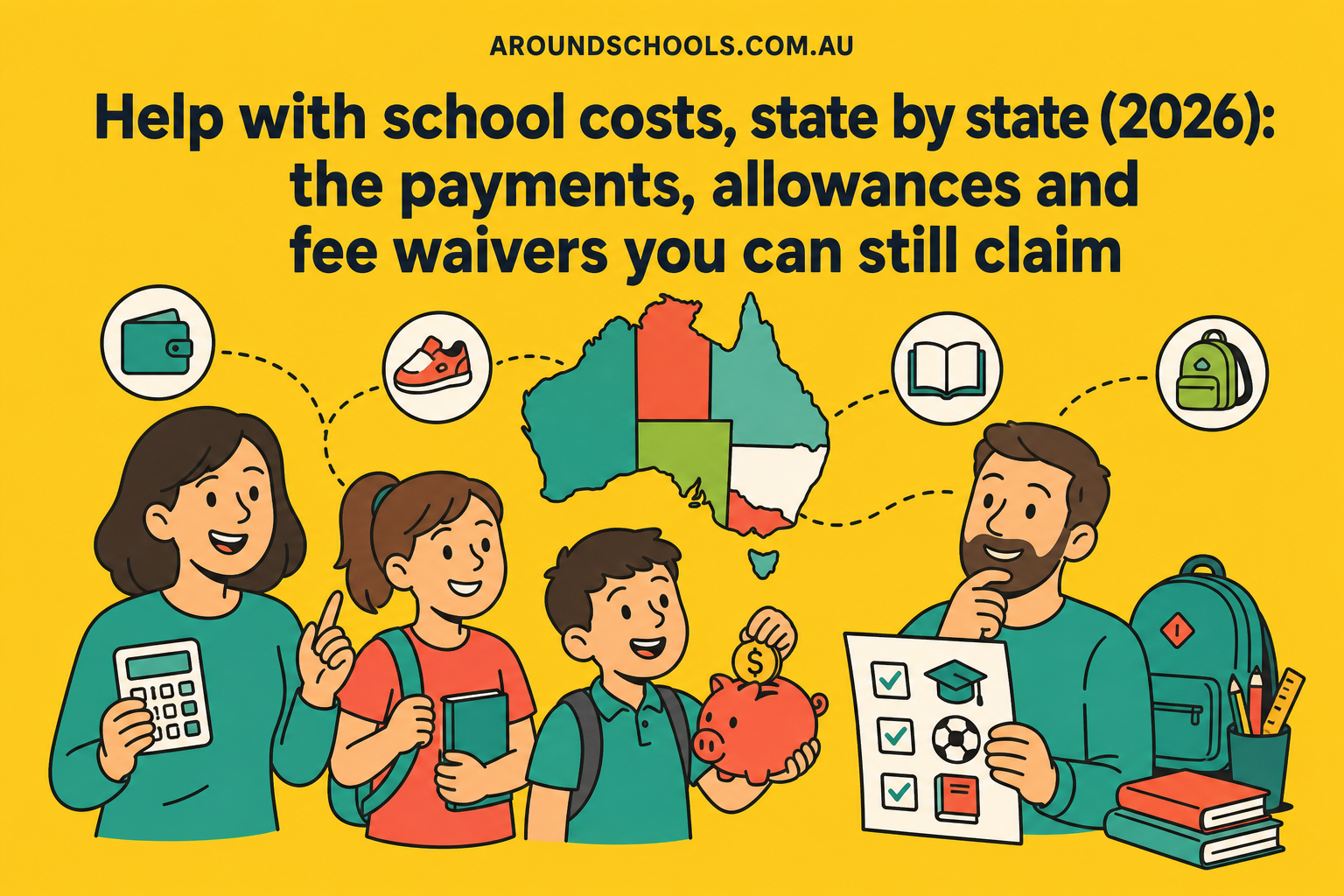
Five states and territories pay families a fixed amount per student towards school costs in 2026 — the ACT up to $750, Victoria $400, Queensland $100 to $357 depending on year level, Western Australia $350 and the Northern Territory $200 — while South Australia and Tasmania waive school charges for low-income families instead, and New South Wales has no statewide payment at all. As of 31 August 2026, two application windows are still open: South Australia's School Card (closes 13 November) and the ACT's Future of Education Equity Fund (closes 27 November). Queensland's and the NT's are automatic through the school; Victoria's and WA's closed mid-year and reopen with the 2027 school year.
Every figure below is from the program's own government page, checked on 31 August 2026.
Key takeaways
- The money ranges from $100 to $750 per student, and it depends entirely on your state: a Canberra high-schooler on a concession card gets $750; the same family in Sydney gets nothing statewide.
- Two windows are open now: SA School Card (to 13 Nov 2026) and the ACT Equity Fund (to 27 Nov 2026).
- Two are automatic: Queensland's Textbook and Resource Allowance and Back to School Boost are credited to state-school accounts; the NT's $200 Back to School Payment is organised by the school.
- Two closed mid-year: Victoria's Camps, Sports and Excursions Fund (26 June) and WA's Secondary Assistance Scheme (2 April). Diarise January.
- Most are card-tested. A Health Care Card or Pensioner Concession Card on the census date is the usual key — keep it current before the school year starts.
The short version
| State | Program | 2026 value | Who qualifies | Window |
|---|---|---|---|---|
| ACT | Future of Education Equity Fund | $400 preschool · $500 primary · $750 high school and college | Low income (means-tested card or evidence) | Open, closes 27 Nov 2026 |
| VIC | Camps, Sports and Excursions Fund (CSEF) | $400 per student | Means-tested card on 28 Jan or 20 Apr 2026 | Closed 26 Jun 2026 |
| QLD | Textbook and Resource Allowance | $164 Years 7–10 · $357 Years 11–12 | All Year 7–12 students | Automatic |
| QLD | Back to School Boost | $100 per Prep–Year 6 student ($150 from 2027) | State school students | Automatic, Term 1 |
| WA | Secondary Assistance Scheme | $235 program allowance + $115 clothing | Concession card, Years 7–12 | Closed 2 Apr 2026 |
| NT | Back to School Payment | $200 per student | Every preschool–Year 12 student | Via the school, spend by end of Term 3 |
| SA | School Card | Waives the school's materials and services charge | Gross family income under $75,524 (one child) | Open, closes 13 Nov 2026 |
| TAS | Student Assistance Scheme (STAS) | Waives levies and stationery | Concession card holders | Open, no published close date |
| NSW | — | No statewide payment | — | Ask the school about hardship help |
Australian Capital Territory: Future of Education Equity Fund — up to $750, open until 27 November
Canberra's scheme is the largest per student: $400 for preschool, $500 for primary and $750 for high school and college, paid to families with parental or financial responsibility for a student enrolled full-time in an ACT public or non-government school. Low income is shown with a current means-tested Health Care Card or Centrelink card that lists the child, or other evidence of low income or financial stress.
It can be spent on uniforms, excursions, sporting equipment, sporting activities and music lessons — which makes it Canberra's stand-in for the kids' activity vouchers other states run. Applications for 2026 opened on 1 December 2025 and close at midnight on 27 November 2026 through the ACT Education SmartyGrants portal; allow up to six weeks for processing.
Victoria: Camps, Sports and Excursions Fund — $400, reopens in January
CSEF was lifted to $400 per student for 2026, from $154 (primary) and $256 (secondary), after the Victorian Government's May 2025 budget commitment of $152.3 million for around 200,000 students. It pays for camps, swimming and school sport programs, outdoor education, excursions and incursions, and graduations, and siblings at the same school can pool it.
Who qualifies: a parent holding a financially means-tested card — a Health Care Card, a Youth Allowance Health Care Card for students 16 and over, or a Veterans' Affairs Gold Card — on the first day of Term 1 (28 January 2026) or Term 2 (20 April 2026). Disability and Carer cards aren't means-tested and don't qualify. Asylum-seeker, temporary-visa and out-of-home-care families can apply under special consideration.
Window: applications went through the school from 19 January and closed on 26 June 2026. The 2027 round will open with the school year — make sure the card is current on the first day of Term 1.
Queensland: two automatic payments
Textbook and Resource Allowance. Every Year 7 to 12 student in a state or approved non-state school, and home-educated students, gets $164 a year in Years 7–10 and $357 in Years 11–12 (2026 rates). In state schools it is applied automatically as a reduction to the Student Resource Scheme fee (or paid to you if the school has no scheme or you've opted out); non-state and home-education families are paid directly. There's no application, but a student who starts after the first Friday in August doesn't get that year's allowance.
Back to School Boost. New in 2026: $100 per Prep to Year 6 student, rising to $150 a year from 2027 to 2030, credited automatically to the school account of every state school student (including special schools, distance education and home education). It is a credit, not a voucher or cash, and it's pro-rated for children who enrol after Term 1.
Western Australia: Secondary Assistance Scheme — $350, reopens in Term 1
WA pays families with a Pensioner Concession Card, Health Care Card or Veterans' Affairs Pensioner Concession Card (the blue card) that names the student a $235 Education Program Allowance (paid to the school against charges) and a $115 Clothing Allowance (paid to your bank account) for each Year 7–12 student, up to and including the year the student turns 18.
The form comes from the school and is accepted in Term 1 only; the 2026 round closed on 2 April 2026 with payments made by 31 May. Ask the school office for the form in the first week of 2027.
Northern Territory: Back to School Payment — $200 for every student
The NT is the only jurisdiction that pays every student with no means test: a one-off $200 per student, per school year, for every child from preschool to Year 12 in an NT government or non-government school, approved home education, or geographically isolated with an interstate boarding allowance.
The school organises and distributes the entitlement — it can only be redeemed at the first school the child attends that year, and it must be spent by the end of Term 3. Siblings at the same school can combine theirs; home-education and interstate-boarding families claim reimbursement for purchases from NT businesses.
South Australia: School Card — fee waiver, open until 13 November
School Card doesn't pay cash; it gives low-income families in government schools (and, at the school's discretion, Catholic and some independent schools) financial help with school fees, materials and services charges, plus a free device in Years 7 and 10 at participating schools. No dollar figure is published because the relief is the school's own charge.
Who qualifies (2026): gross family income for 2024–25 of $75,524 or less with one child, rising by $1,349 for each additional child ($76,873 for two, $78,222 for three, $79,571 for four). Family Tax Benefit, child maintenance and Carer Allowance don't count as income. There are separate forms for hardship or a change in circumstances (Form B), recent migrants, veterans, adult re-entry students, Independent Youth Allowance recipients and grandparent or court-ordered carers.
Window: applications for 2026 are open and close on 13 November 2026. Lodge Form A at each child's school; Form B goes to the School Card Section (1800 672 758).
Tasmania: Student Assistance Scheme — levy and stationery waiver
STAS is a full waiver of levies and stationery for Kindergarten to Year 12 students in Tasmanian government schools — not a payment. Catholic schools assess their own version and independent schools decide case by case. Eligibility is card-based: a parent holds a Health Care Card, Low Income Health Care Card or Pensioner Concession Card; students in out-of-home care are approved automatically, and grandparent carers and humanitarian-visa families are eligible. Home-educated students aren't.
Apply online through the Department for Education, Children and Young People; no 2026 closing date is published, so apply as soon as the card is in hand. The same guideline funds a $1,472-a-year Student Accommodation Allowance for Year 11–12 students living more than 40 km from school.
New South Wales: nothing statewide — but schools must help
NSW has no back-to-school payment in 2026. The 2023 $150 voucher and the 2022–23 $500 Before and After School Care voucher have both closed, and Service NSW's student-support page now lists only ABSTUDY, Assistance for Isolated Children, boarding support, living-away-from-home allowances, transport concessions and the Active and Creative Kids voucher.
What NSW does have is a rule inside the schools: voluntary contributions are exactly that — the Department of Education says they are "at the discretion of parents and carers" with no incentive or penalty attached — and for mandatory excursions and specialist activities, schools must provide student assistance to cover part or all of the cost in cases of financial hardship. Ask the principal or the office confidentially; the request is routine.
How not to miss the window
- Get the card current before the census date. Victoria checks on 28 January and 20 April; WA and SA check at application. A card that lapses over summer costs you the year.
- Ask the school office in the first week. VIC, WA, NT and SA all run through the school. Offices know the forms and, in the NT and QLD, do the work for you.
- Diarise the two open windows — 13 November (SA) and 27 November (ACT) — and January for the two that reopen (VIC, WA).
- Keep receipts where the scheme reimburses (NT home-education families, ACT Equity Fund purchases).
Stack it with the activity vouchers
These payments are for school charges; the kids' sport and activity vouchers are a separate pot for the after-school side, worth $100 to $500 a year per child in every state except the ACT — and they usually key off the same Health Care Card or Family Tax Benefit that unlocks the school help. The state-by-state voucher guide has the amounts and the open rounds; the Child Dental Benefits Schedule is the third scheme on the same eligibility signal. If you're weighing a fee-paying school, the school fees explorer shows what a year actually costs by state.
Frequently asked questions
My child is at a Catholic or independent school — do these apply? Sometimes. Queensland's allowance and the NT payment cover non-state schools; the ACT fund covers non-government schools; SA's School Card covers Catholic schools and independent schools at their own discretion; Victoria's CSEF and WA's scheme are for registered schools generally. Tasmania's waiver is government schools only.
We don't have a concession card. Is there anything? Queensland (all Year 7–12 students, and all Prep–6 in state schools) and the NT (every student) pay regardless of income. SA's School Card uses an income test rather than a card. Elsewhere, ask the school about hardship assistance — every system has it.
Can I claim for last year? No. Every scheme is for the current school year, and the closed ones (VIC, WA) don't accept late applications.
Is the money paid to me or the school? Mostly the school: Victoria, WA's program allowance, Queensland, the NT, SA and Tasmania all offset school charges or credit the school account. WA's $115 clothing allowance and the ACT fund go to the family.
Does this cover uniforms? WA's clothing allowance and the ACT fund do explicitly; the NT payment is spent through the school on school needs; the others are for fees, camps, excursions and resources.
Correct as at 31 August 2026. Sources, each read on that date: act.gov.au "Get help with the cost of schooling" and the Education Equity Fund 2026 SmartyGrants page; vic.gov.au Camps, Sports and Excursions Fund; education.qld.gov.au Textbook and Resource Allowance and qld.gov.au Back to School Boost; education.wa.edu.au Secondary Assistance Scheme; nt.gov.au Back to School Payment Scheme; education.sa.gov.au School Card and the 2026 Form A and Form B; decyp.tas.gov.au Student Assistance Scheme and the Student Financial Assistance Guideline; service.nsw.gov.au financial support for students and the NSW Department of Education's voluntary school contributions policy. Windows and amounts change each school year — check the state page before you rely on a date.