What Six Years of Private School Actually Costs - and How Families Pay For It
19 August 2026
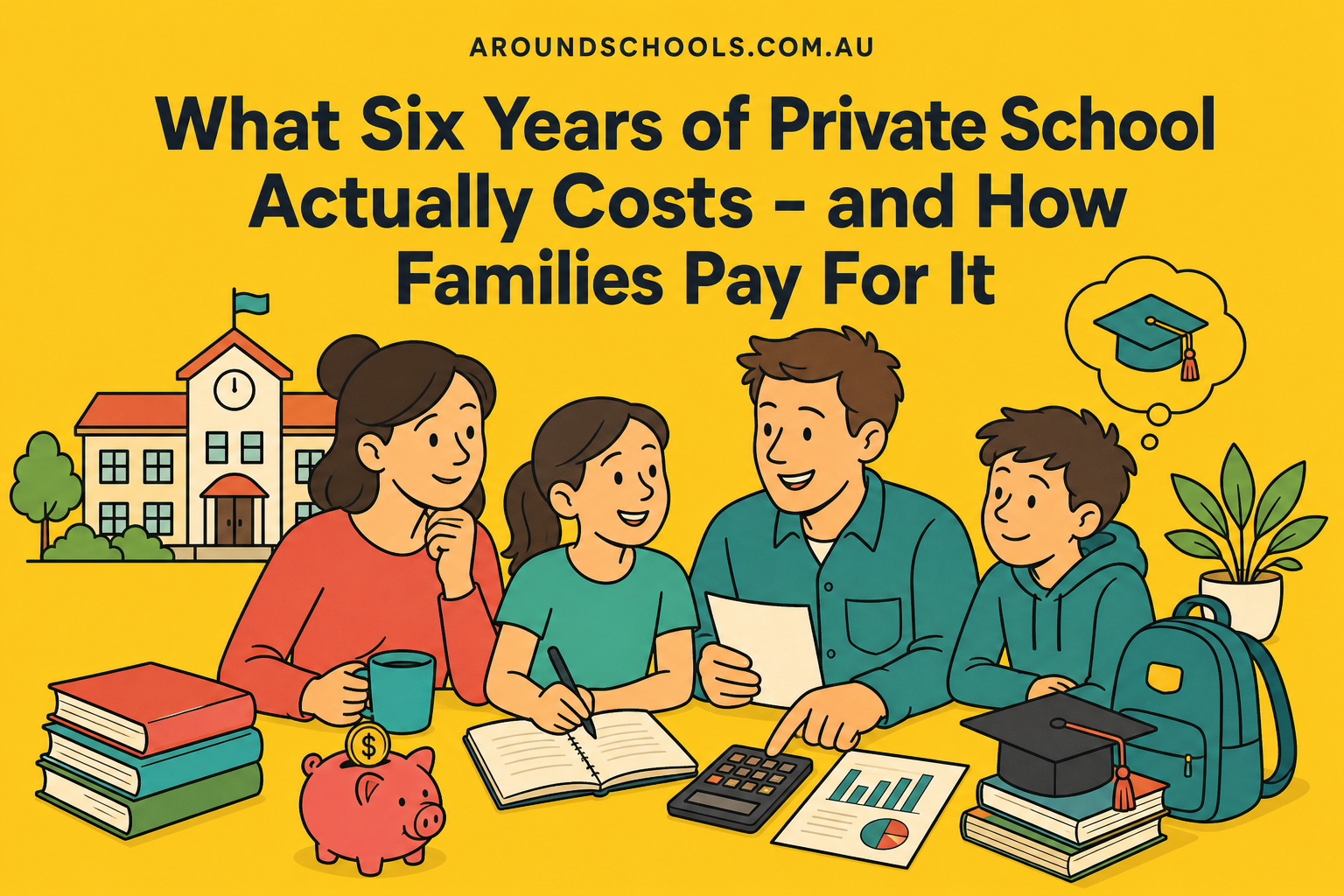
What Six Years of Private School Actually Costs - and How Families Pay For It
Important: this article is general factual information only, and is not financial advice. AroundSchools does not hold an Australian Financial Services Licence (AFSL) and does not recommend any financial product or strategy. Nothing here takes account of your objectives, financial situation or needs. Before making any financial decision, speak to a licensed financial adviser and read the relevant Product Disclosure Statement (PDS).
Six years of private secondary school costs anywhere from about $17,800 to more than $314,000 in tuition alone, depending almost entirely on the school you pick — not the state you live in. A Catholic systemic college and a top-tier independent are both "private school", and the gap between their six-year fees is roughly eighteen-fold. That is per child, and tuition is only the start: uniforms, devices, camps, excursions and building levies sit on top, and for some sectors they cost more than the fees do.
Most articles about school fees quote a single year. Families pay for six years of secondary — thirteen if you count primary — which is why "can we afford this school?" is really a question about years of cash flow, not one invoice. Below are the real numbers, drawn from each school's own 2026 fee schedule and the national Cost of Education Index, and then the six ways Australian families actually pay for it.
Key takeaways
- Six years of secondary tuition ranges from ~$17,800 to $314,000+ — the school and sector decide the cost far more than the state does.
- Independent tuition at the top end (Sydney Grammar) is a flat $52,410 a year in 2026; a Catholic systemic college in western Sydney charges about $2,500–$3,600 a year.
- The whole 13-year journey, K–12, runs about $113,594 (government), $247,174 (Catholic) and $369,594 (independent) across the major cities — but those totals are mostly not tuition (see below).
- Fees are rising at about 5–6% a year, roughly double CPI (ABS, via the Futurity 2026 index) — faster than the "4%" often quoted.
- Fees are paid from after-tax income by most families, which is why the tax treatment of any savings vehicle is the thing worth understanding.
- Figures below are each school's published 2026 schedule, verified at source in September 2026. Every school revises fees annually — confirm before you commit.
What six years of secondary actually costs: three real schools
We could quote a state "average", but it would be close to meaningless — Australian schools publish fees on incompatible bases, and one number hides the thing that matters, which is how much the specific school charges. So here are three real schools across the range, each figure summed from the school's own published 2026 fee schedule and checked at source in September 2026.
| School (sector) | 2026 Year 7 fee | Six years, Years 7–12 (tuition) |
|---|---|---|
| Diocese of Parramatta systemic (Catholic) | $2,532 | $17,838 |
| St Mary's Cathedral College, Sydney (Catholic) | $6,980 | $42,050 |
| Sydney Grammar School (Independent) | $52,410 | $314,460 |
How we worked this out. Each six-year figure is the sum of the school's published 2026 day-tuition for Years 7 to 12 (first child). Parramatta sets tuition centrally across the diocese — $2,532 for Years 7–8, $2,808 for Years 9–10, $3,579 for Years 11–12 — plus a $945-a-year building levy. St Mary's Cathedral College's Years 7–12 run $6,980 / $6,550 / $7,032 / $6,422 / $7,708 / $7,358, plus a $1,117 building levy. Sydney Grammar charges a flat $52,410 across all six forms, plus a one-off $8,735 entrance fee. These are tuition only — the all-in figure, with levies, uniforms, devices and camps, is higher at every school. Ask any school for its full 2026 schedule for the year your child would start.
Two things that table makes plain. The sector and school matter far more than the state: a Catholic systemic college costs less in six years than a top independent charges in one. And the number you are quoted is almost never the number you pay — the gap between advertised tuition and the all-in cost is frequently four figures a year.
The whole journey, K–12, by state
For the full thirteen years — the number a family starting Prep today is really signing up for — the best national source is Futurity Investment Group's Cost of Education Index 2026 (conducted by Resolve, 2,502 parents). It projects the total cost of schooling for a child starting in 2026 and finishing in 2038, by sector and state, across the major cities:
| State (major cities) | Government | Catholic | Independent |
|---|---|---|---|
| New South Wales | $106,567 | $223,919 | $401,512 |
| Victoria | $121,202 | $247,999 | $435,902 |
| Queensland | $120,486 | $273,494 | $423,378 |
| Western Australia | $102,600 | $253,324 | $331,525 |
| South Australia | $111,630 | $249,830 | $304,997 |
| National (major cities) | $113,594 | $247,174 | $369,594 |
Read those totals carefully — they are not tuition bills. The Futurity figure bundles fees together with parent contributions and ancillary spending: uniforms, devices, excursions, tutoring, transport. For government schools, about 90% of that $113,594 is ancillaries, not fees; for Catholic it is about 64%, and for independent about 38%. That is why a "free" government education still lands near $113,000, and why the National Catholic Education Commission publicly called the index "misleading" in January 2026, arguing it overstates fees by rolling in extras from a small parent-spending sample. Both things are true: the ancillary costs are real money families spend, and they are not what a school invoices as tuition. Treat the table as "total cost of raising a school-age child through the system", and the three-school table above as "what the school actually charges".
Two more warnings. Futurity does not publish a separate primary-versus-secondary split, so the six-year secondary figure has to come from the schools' own schedules (as above), not from this index. And the index projects fees rising at 5–6% a year — roughly double CPI, on ABS data; a family starting Year 7 today should budget for meaningfully more by Year 12 than today's schedule shows.
Six ways Australian families fund it
1. From income, year by year
The most common route, and the reason fees feel heavier than the sticker price: school fees are paid from after-tax income. A family paying $9,000 a year in fees on a 37% marginal rate is earning roughly $14,300 before tax to cover it. Nothing is wrong with paying from cash flow — it just means the effective cost is higher than the number on the invoice.
2. Discounts most families never ask about
Schools have more flexibility than their fee schedules suggest:
- Sibling discounts — commonly 5–20% for a second or third child, and often not advertised.
- Prepayment discounts — a reduction for paying the year in full up front rather than by instalment.
- Bursaries and means-tested assistance — many schools hold funds specifically for existing families whose circumstances change. Schools rarely promote these, and they are almost never automatic. Ask the registrar directly.
3. Scholarships
Academic, music, sport and general-excellence scholarships can cover anywhere from 10% to 100% of tuition. Most Australian schools test in February to May for entry the following year, and registrations typically open between August and October. We have written separately about which schools offer scholarships and about how the ACER, EduTest and AAS tests differ.
4. Saving ahead in an ordinary account
Straightforward and flexible: a savings account or term deposit in the parent's name. Earnings are taxed at the account holder's marginal rate each year. Accounts held in a child's name are taxed at higher rates on unearned income above a low threshold — a factual point worth being aware of, and one to raise with an adviser or the ATO's published guidance.
5. Education bonds
An education bond is a long-term investment structure designed specifically for education costs, offered in Australia by a small number of issuers — Futurity Invest and Australian Unity's Lifeplan are the two most commonly used. Factually, and according to the issuers' own published material, here is how they work:
- The bond pays the tax on investment earnings as they accrue, rather than the investor declaring them each year. Futurity states this is at a rate of up to 30%.
- When earnings are withdrawn to pay education expenses, the tax already paid is refunded into the withdrawal. Both issuers describe this as worth up to $30 for every $70 of earnings used for education.
- Your own contributions come back as a tax-free return of capital, withdrawable at any time and for any purpose.
- Eligible expenses are broad. Australian Unity's list runs from tuition fees and HELP debts through to uniforms, books, music lessons, instruments, sports equipment, school outings and travel.
- Entry is modest — Australian Unity's Lifeplan takes a minimum initial contribution of $1,000 and a minimum withdrawal of $500, with no establishment, contribution, withdrawal or exit fees on that product.
- A beneficiary is nominated — anyone 16 or over can open a plan and nominate a student.
Education bonds sit within the broader family of investment (insurance) bonds, which carry their own long-standing rules on holding periods and how much you can add each year. Those rules, the investment options, and the fees that apply to the underlying portfolio differ between products — they are set out in each issuer's Product Disclosure Statement, and that is the document to read before contributing.
Whether this structure suits you depends entirely on your marginal tax rate, your timeframe and your circumstances. That is an assessment for a licensed adviser, not an article.
6. Grandparents and family contributions
Increasingly common. In practice, some families seek professional advice on how to structure these contributions — particularly where a grandparent wants the money quarantined for education specifically, or wants it to sit outside their estate. Education bonds are one of the structures used in practice for this, because the contributor and the nominated student can be different people. How any arrangement should be structured for your family is a question for a licensed financial adviser and, where relevant, a tax or estate-planning professional.
The routes, side by side
The table below is a factual summary of the objective characteristics of each route. It is not a recommendation of any route or product. Which, if any, suits your family depends on your circumstances — a question for a licensed financial adviser.
| Route | How it is used in practice | Objective characteristics |
|---|---|---|
| Paying from income | The most common route | Paid from after-tax dollars — a $9,000 fee corresponds to roughly $14,300 of pre-tax income at a 37% marginal rate |
| Sibling and prepayment discounts | Offered at each school's discretion | Rarely advertised — you have to ask the registrar directly |
| Bursaries | Offered by some schools, means-tested | Never automatic; must be applied for |
| Scholarships | Offered by schools via competitive selection | Testing is competitive and the registration window (Aug–Oct) closes early |
| Saving in an ordinary account | A common savings approach | Earnings are taxed at the account holder's marginal rate each year |
| Education bonds | A long-term investment structure offered by a small number of issuers | Long-term structure with its own rules and fees; tax treatment is set out in each issuer's PDS |
The differences between these routes in timeframe and tax treatment are matters of fact — but what those differences mean for you depends on your personal circumstances. Speak to a licensed financial adviser.
Saving and investing ahead: four vehicles, and the catch with each
If you would rather get ahead of the bill than pay it from each year's pay packet, four vehicles do most of the work in Australia: an ordinary savings account, an ETF or managed fund, an investment bond, and a dedicated education bond. They differ mostly on two things — how the earnings are taxed, and how freely you can get your money back. Here is what each is good for, and the catch with each.
This is general information, not personal financial advice. Product features, fees and tax rules change; read the current Product Disclosure Statement and consider a licensed financial adviser and a registered tax agent before acting.
The number you are saving toward. For the whole journey, the Futurity totals above — about $113,594 (government), $247,174 (Catholic) and $369,594 (independent) across the major cities — are the target. Put the independent figure on a monthly footing and the case for starting early is stark. Save from birth to the end of Year 12 — 18 years — with the money sitting in cash earning nothing, and you would need to set aside about $1,711 a month for an independent education, $1,144 for Catholic, or $526 for government. That zero-return figure is exactly the number an investment vehicle is built to shrink: the point of investing ahead is to let compound growth cover part of the bill, so you contribute less than the sticker price.
The savings account
Safe and simple. Your deposit is government-guaranteed up to $250,000 per person per bank under the Financial Claims Scheme, and you can reach it any time. The catch: the interest is taxed every year at your marginal rate, so it barely keeps pace with fee inflation — and money held in a child's own name is taxed at high penalty rates once it passes a small annual threshold, which is why families who save this way keep the account in the lower-earning parent's name. Best as a short-term buffer, not a 13-year plan.
An ETF or managed fund
Over a long horizon, a low-cost share fund has historically done the heaviest lifting on growth, and you can sell whenever you like. The catch: you declare the earnings and any capital gains at your own marginal rate, there is no built-in discipline to stop you dipping in, and shares can fall — so it suits money you will not need for at least five years, held in a parent's name.
An investment bond
An investment bond — also called an insurance bond — pays tax on its earnings inside the bond, at the company rate of 30%. ASIC's Moneysmart notes that if you make no withdrawals in the first 10 years, no further tax is payable, and that these bonds are "tax effective for investors with a marginal tax rate higher than 30%." The catch: if your own marginal rate is below 30%, that internal 30% is a drag rather than a saving, and contribution and 10-year rules limit how you top it up. It is a higher earner's tool.
An education bond
An education bond is an investment bond with an extra feature aimed squarely at study costs. Futurity — the provider formerly known as Australian Scholarships Group (ASG), which rebranded in 2019, so if you see both names they are the same organisation — states that it "pays tax on the bond's ongoing investment earnings at a tax rate of up to 30 percent on your behalf," and that when you withdraw earnings to pay education costs "you'll enjoy a refund of the tax paid by us which gives you an extra $30 for every $70 dollars withdrawn." Australian Unity's Lifeplan education bond describes the same benefit in the same terms. In plain numbers, $70 of earnings used for education stretches to about $100.
Why parents like them: the money is earmarked for education, the tax is handled for you, and — unlike the old pooled scholarship plans these providers used to run — today's bonds let you "access capital tax free at any time" and withdraw "for any purpose." So the worry that used to put families off, what if my child doesn't go on to study?, no longer means losing your savings: you keep your capital and can spend it on anything. What you would miss is only the 30% education refund on the earnings, not the money itself.
The catch: the same below-30%-marginal-rate drag applies, and the fees are not shown on the marketing pages — they sit in the Product Disclosure Statement, which is where the older scholarship-plan versions of these products drew their heaviest criticism. Read the current PDS (Futurity's is the 2026 edition) and check the fees before you commit.
The vehicles at a glance
| Vehicle | How earnings are taxed | Best for | The catch |
|---|---|---|---|
| Savings account | Your marginal rate, every year | A short-term buffer | Barely beats fee inflation; penalty tax if held in a child's name |
| ETF or managed fund | Your marginal rate, on income and gains | Long horizons and flexibility | Volatile; no earmarking discipline |
| Investment bond | 30% inside the bond; nil after 10 years | Earners taxed above 30% | A drag if your rate is below 30%; contribution rules |
| Education bond | 30% inside the bond, refunded for education | Earmarked education saving by higher earners | Fees sit in the PDS; refund only on money used for study |
There is no single right answer here — the best vehicle depends on your marginal tax rate, how many years you have, and whether you value flexibility or discipline more. For most families it is a mix: a buffer in cash, the long money in a low-cost fund or an education bond, and a clear-eyed read of the actual fees in the PDS.
What we would weigh alongside the money
Fees are one line in the decision. A shorter commute, a school your child can get to independently by Year 9, and activities that actually run near home are worth real money and real hours. You can compare schools by state, check what a suburb offers in our kids' activity index, and read our breakdown of Catholic versus independent fees before you shortlist.
Frequently asked questions
How much does private school cost in Australia in total? It depends far more on the school than the state. Six years of secondary tuition runs from about $17,800 at a Catholic systemic college to over $314,000 at a top independent, on 2026 schedules. Across the whole thirteen years, the Futurity 2026 index puts the total cost — fees plus contributions and ancillaries — at about $113,594 for government, $247,174 for Catholic and $369,594 for independent in the major cities.
Do private school fees go up every year? Yes. The Futurity 2026 index, citing ABS data, puts the rise at about 5–6% a year — roughly double CPI — which is why planning against today's fee schedule understates the total. Confirm each school's own increase, as they vary.
Why is even a "free" government school listed at over $113,000? Because that figure is the total cost of thirteen years, and for government schools about 90% of it is ancillaries — uniforms, devices, excursions, technology, transport — not tuition. The Catholic sector has publicly disputed how those ancillaries are estimated; read the total as household spending across schooling, not as a fee.
What is an education bond? A long-term investment structure for education costs where, according to the issuers' published material, the bond pays tax on earnings as they accrue, and refunds that tax — up to $30 for every $70 of earnings — when the money is withdrawn to pay eligible education expenses. Contributions come back as a tax-free return of capital.
Are education bonds better than a savings account? That depends on your marginal tax rate and timeframe, and it is a question for a licensed financial adviser. What can be said factually is that the two are taxed differently: a savings account's earnings are taxed at your marginal rate each year, while an education bond's are taxed inside the bond with a refund available for education withdrawals.
Can grandparents pay school fees directly? Yes, and many do. The structures used vary depending on whether the money should be quarantined for education, and on estate considerations — a question for a licensed adviser before setting anything up.
General factual information only. This article is not financial advice. It does not consider your objectives, financial situation or needs, and is not a recommendation to acquire any financial product. AroundSchools does not hold an Australian Financial Services Licence. Product details are drawn from the issuers' own published material — always read the Product Disclosure Statement and speak to a licensed financial adviser before deciding. School fee figures are each school's own published 2026 schedule, verified at source in September 2026; the 13-year totals are from Futurity Investment Group's Cost of Education Index 2026.